 SAMOURAÏ COOP
Cooperative & Web3 Glossary (V.0.1)
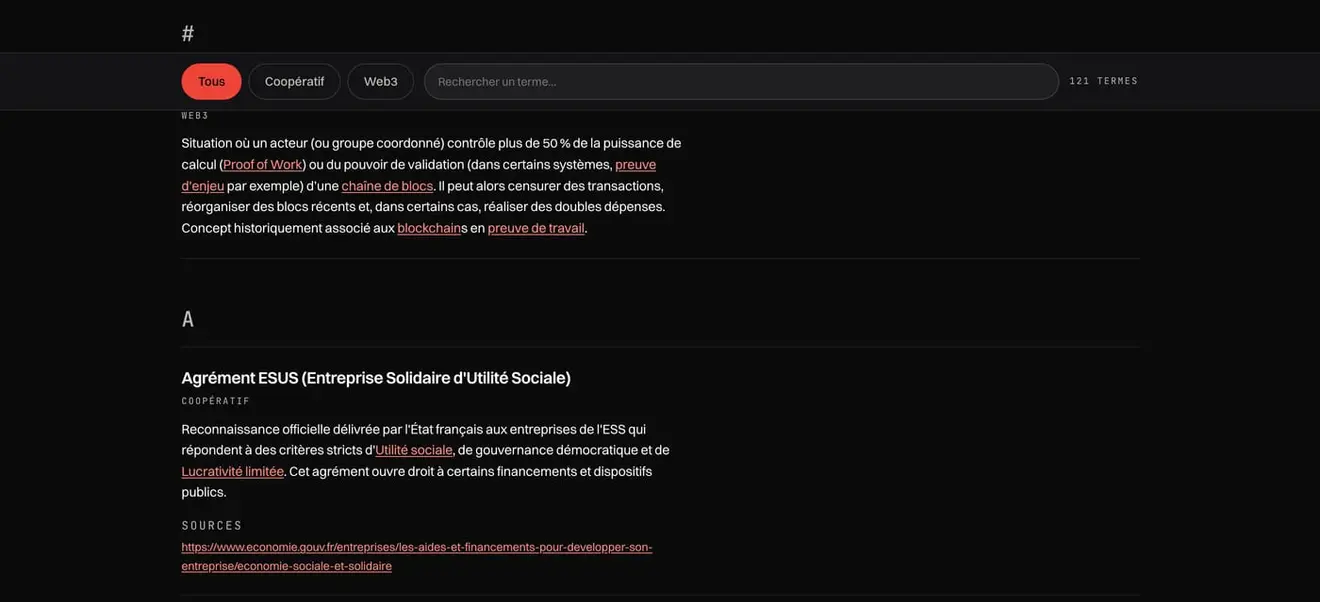
That’s it, the first version of the Cooperative & Web3 glossary is online! Incomplete, but necessary, it lays the foundations for a living tool, designed to evolve with you.
👉 Access the glossary:https://samouraiworld.github.io/gov-research-wiki/
Elements of Translation for Shared Governance
This glossary continues the translation efforts that already structured my PhD thesis (contributions highlighted in my general conclusion, downloadable here, in french). My thesis identified that a certain contempt and mutual misunderstanding between coiners and money professionals (economists, bankers, central bankers) explained the complicated reception that the academic world reserved for cryptocurrencies. Like the glossary I developed in my thesis, this one is designed as a bridge, a gateway between two worlds that misunderstand or even ignore each other: here, the observation concerns the cooperative world and that of distributed ledger protocols (or Web3) which, despite shared values—democratization, shared governance, collective ownership—struggle to dialogue, for lack of a common language.
In the spirit of the sociology of translation, developed notably by Michel Callon, Bruno Latour, and Madeleine Akrich, our approach consists of creating a translation space between the worlds of Web3 and the cooperative economy, in order to make their concepts mutually audible and operational. Beyond simply defining terms, this glossary aims to be a meeting point, seeking to make intelligible the practices, imaginaries, and controversies that animate each ecosystem. Like the scallop larvae and the fishermen of the Bay of Saint-Brieuc studied by Callon, this tool must foster mediation between coiners and actors of the cooperative world: the constitution of a scientific language (etic) based on the actors’ own language (emic) aims to enable not only speaking about them, but also dialoguing with them.
For example: a DAO (Decentralized Autonomous Organization) and a SCOP (Société Coopérative et Participative — Worker Cooperative) share the idea of collective governance by a diversity of members, but differ radically in their mechanisms (on-chain voting vs. general assembly, profit-seeking vs. limited profitability, governance token weight vs. one person = one vote). This glossary aims to make these differences intelligible, without flattening them.
We start from the principle that knowledge is constructed through interaction and, if the converse is true, it is on the condition of understanding each other, which makes necessary… translation.
This work is intended for both cooperatives curious about Web3 and Web3 communities wishing to understand existing cooperative frameworks. It aims to:
- Offer actors in the cooperative world keys to understanding the technical, organizational, and political stakes of Web3 (DAOs, smart contracts, tokens, etc.).
- Provide Web3 communities with insight into the richness, anteriority, and diversity of cooperative models (SCOP, SCIC, sociocratic governance, indivisible reserves, etc.).
- Identify possible hybridization zones where cooperative principles can enrich Web3 protocols, and where decentralized tools can strengthen cooperative governance (for a more analytical V2).
This glossary is not an end in itself, but a tool under open construction. The first version published today offers consolidated and cross-cutting definitions, while acknowledging imperfections. Already, references are not yet systematically detailed entry by entry and some are minimal: resulting from research work, reformulation, and conceptual translation assisted by AI tools, the improvement of each entry and their sourcing (legal articles, institutional texts, educational resources) will be the subject of:
- progressive enrichments,
- external contributions,
- and subsequent versions of the glossary.
This first version also assumes a certain asymmetry: entries related to Web3 reflect more our research anchoring in this ecosystem, while enrichments on the cooperative side will come with acquired experience and contributions from ESS practitioners. Future versions will be completed with analysis sections (Web3–coop translations, conceptual tensions, examples), by us and with the community. The goal is less to freeze a vocabulary than to collectively document practices and meanings over the long term.
In this first version, the definitions are based notably on:
- French cooperative law (legal references)
- Légifrance (Commercial Code, ESS law, standard statutes, etc.): https://www.legifrance.gouv.fr/
- Cooperative / ESS resources (networks & institutions)
Coop FR - Cooperative enterprises:
-
general definition https://www.entreprises.coop/qu-est-ce-qu-une-cooperative
-
social and solidarity economy: https://www.entreprises.coop/l-economie-sociale-et-solidaire
-
Reference texts: https://www.entreprises.coop/textes-de-reference International Cooperative Alliance (ICA) — identity, values, principles:
-
Cooperative identity: https://ica.coop/fr/coop%C3%A9ratives/identite-cooperative
-
History / chronology: https://ica.coop/fr/coop%C3%A9ratives/histoire-du-mouvement-cooperatif
-
What is a cooperative?: https://ica.coop/fr/coop%C3%A9ratives/quest-ce-quune-cooperative General Confederation of SCOP / SCOP–SCIC network:
-
Legal guide for SCIC: https://www.les-scic.coop/le-guide-juridique-des-scic
-
Bibliography: https://www.les-scop.coop/bibliographie
-
Directory (e.g. Samouraï Coop): https://www.les-scop.coop/samourai-coop
-
Tools / legal monitoring: https://www.les-scop.coop/conseil-et-suivi-juridique
-
Reference (Avise sheet): https://www.avise.org/annuaire/confederation-generale-des-scop
- Research work (analytical frameworks)
- Our knowledge in social sciences and political economy (commons/Ostrom, institutionalism, ESS, etc.).
- Web3 / cryptocurrency resources (lexicons & educational syntheses)
- Bitcoin.fr — vocabulary: https://bitcoin.fr/vocabulaire/
- Consensys — “A Blockchain Glossary for Beginners”: https://consensys.io/knowledge-base/a-blockchain-glossary-for-beginners
- Object Computing — “Blockchain Glossary of Terms”: https://objectcomputing.com/expertise/blockchain/glossary
- Fintech Magazine — “Ultimate A-Z Glossary”: https://fintechmagazine.com/financial-services-finserv/140-blockchain-and-crypto-words-ultimate-z-glossary
Glossary Structure and Methodology
👉 Access the glossary: https://samouraiworld.github.io/gov-research-wiki/
The glossary is organized into two distinct parts:
- Part 1: Terms from the cooperative world (for Web3 neophytes )
- Part 2: Terms from the Web3 world (for cooperative neophytes)
Each glossary entry follows a 5-point structure:
- Definition ✅ (present in V.0.11)
- Correspondence level ⚠️ (to be completed: equivalence, proximity, opposition, absence)
- Conceptual tensions ⚠️ (to be completed)
- Examples ⚠️ (to be completed)
- Sources ✅/⚠️ (partially present in V.0.1)
This structure reflects the desire to grasp, beyond definitions, levels of correspondence / tensions that would exist between the crypto and cooperative worlds.
A 4-Level Approach to Correspondence
The glossary does not aim to force symmetries between the cooperative and Web3 worlds, and the proposed correspondences follow four levels:
- Real functional equivalences: Concepts that fulfill similar functions in both ecosystems, despite different technical modalities. Example: multisig wallet ↔ dual signature by the board of directors ; fork ↔ cooperative split.
- Proximities with tensions: Concepts that share an ambition or common logic, but diverge significantly in their implementation. Example: governance token vs. social share; DAO vs. cooperative.
- Frank oppositions: Principles that structurally oppose each other between the two models. Example: “one token = one vote” vs. “one person = one vote”; speculation vs. indivisibility of shares.
- Absence of equivalent: No solid functional or conceptual equivalent is identified. These “non-correspondences” signal less a lack than a possible invention space between cooperative and Web3 worlds.
V.0.1 offers consolidated definitions and some sources, but points 2, 3, 4, and 5 remain largely to be completed. This is where your contributions will be most valuable!
Call for Contributions
This glossary is designed as a living tool, open to criticism and appropriation: it is not intended to be “finished,” but to be progressively enriched through feedback and contributions from the Samouraï Coop community, SSE practitioners, and Web3 actors.
Therefore, if you spot gaps, inaccuracies, or disagreements, or if you wish to propose new terms or examples, you can contribute to enriching it. Your feedback will help improve existing definitions, enrich the cooperative part, and prepare future versions (Web3–coop translations, case studies, controversies, etc.). Thus, this V.0.1 is only the starting point for conversations, collaborations, and, we hope, common constructions.
Some Principles
No technical expertise is required to contribute.
Any remark is welcome, whether it’s a correction, a disagreement, or a proposal for a new term.
Example: You are a member of a SCIC and find that the definition of “multi-stakeholder” lacks clarity? Open an Issue to propose a reformulation or a concrete example. You contribute to a DAO and think that the term “on-chain governance” deserves a nuance? Propose a Pull Request. Every contribution, however small, enriches the glossary.
Expected Types of Contributions
Contributions can take very diverse forms:
Contribution Type Example Add term
Add ‘indivisible reserves’ (SCIC)
Improve definition
Clarify ‘smart contract’ for a non-technical audience
Add example
Illustrate ‘DAO’ with the Aave case
Internal cross-reference
Link ‘token’ to ‘on-chain governance’
Signal tension
Point out the ambiguity between ‘decentralization’ (Web3) and ‘democracy’ (coop)
There is no contribution “too small”: a new word, a new formulation, a sentence, a remark, a source, or a question can already make the glossary evolve.
Contribution Methods
To facilitate participation, two contribution modes are possible, depending on your comfort with digital tools.
A) Simple Contribution (without GitHub knowledge)
This is the most accessible method.
Simply open an Issue (a discussion ticket) on the glossary’s GitHub repository:
👉 https://github.com/samouraiworld/gov-research-wiki/issues
In this Issue, you can freely:
- propose a new term to add to the glossary
- report an inaccuracy, error, or gap
- suggest a cooperative or Web3 nuance
- share a concrete example or use case
- express a reasoned disagreement on a definition
A simple text message is enough. The team then takes care of integrating the proposal or opening the discussion.
This is the recommended mode if you are discovering GitHub or simply want to provide feedback.
B ) Direct Text Contribution (glossary editing)
For people more comfortable with GitHub, it is possible to directly propose content modifications.
The process is as follows:
- Open an Issue (recommended, even briefly) → to explain what you wish to modify or add.
- Propose a Pull Request (PR) → that is, a direct modification of a glossary file (definitions are in the
./sources/folder). - Collective discussion → changes can be discussed, adjusted, specified.
- Validation and integration (merge) → once validated, the modification is integrated into the glossary.
A detailed contribution guide (CONTRIBUTING.md) will soon be added to guide new people step by step.
A Documentary Common
This glossary is also a research-action experiment in itself: an attempt at collective governance of language, at the crossroads of cooperatives, Web3, and the commons.
By contributing, you participate not only in a practical tool, but also in a collective reflection on how we name, organize, and govern our infrastructures.
Ready to contribute? Go to the GitHub repository to open your first Issue, or browse the glossary to discover the terms already documented. And if you have questions, don’t hesitate to contact us!
👉 Access the glossary: https://samouraiworld.github.io/gov-research-wiki/
👉 Contribute: https://github.com/samouraiworld/gov-research-wiki/issues
License: This glossary is published under CC-BY-SA 4.0 license, which means you are free to reuse, modify, and redistribute it, provided you cite the source and share your modifications under the same license.