 SAMOURAÏ COOP
Case study · Film crew
The Underground Sistine Chapel
A feature documentary, funded in cryptocurrency and released free on decentralised networks.
Client
None — produced by the coop
Crew
Film
Scope
Direction · Cinematography · Post-production · Distribution
Format
Feature documentary · 2021 · 78 min
01
The ask
Nobody commissioned this film.
We wanted to document the work of an artist whose approach runs against the grain of contemporary art, and we wanted total freedom in how the film was made and in how it reached people. No broadcaster, no distributor, no commission — which meant no one to answer to, and no one to fall back on.
02
The why
The subject funds his work outside the institutions. So did the film.
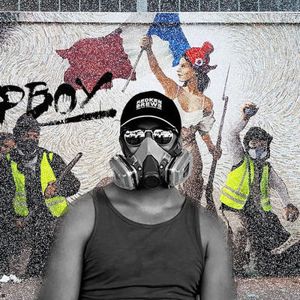
Pascal “Pboy” Boyart grew up near La Chapelle — which he calls the birthplace of European graffiti — and spent close to fifteen years covering Paris in ultra-realistic frescoes before turning to monumental portraits and the expressive weight of a gaze. By his own account, he was the first mural painter to affix a Bitcoin QR code to a painting so a passer-by could pay the artist directly, and the first to turn murals into digital collectibles. Financing a film about that through the ordinary circuit would have contradicted the thing being filmed.
- Source:pboy-art.com
03
The constraint
A working gold foundry is not a film set, and eight months is not a visit.
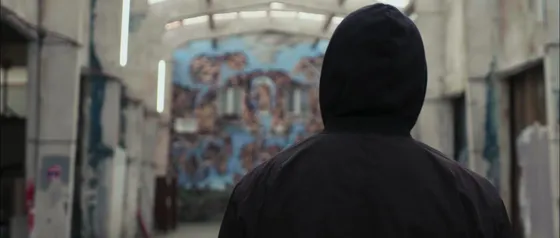
The fresco went up inside a former gold foundry on the edge of Paris — a place living its thousandth life, held together by people whose stories are as varied as they are fiercely non-conformist. They defend the place’s autonomy and leave its doors open at the same time. Filming there for eight months meant being accepted rather than granted access: no lighting rig anyone had to work around, no schedule anyone had to keep but ours, and no second chance at a day that had already happened.
04
How we built it
Funded in cryptocurrency, cut over four months, scored from scratch.
Shooting ran eight months from June 2020. Post took four from January 2021 — edit, colour grade, sound mix and an original score. The budget came from cryptocurrency rather than the French funding circuit, a route we chose for the freedom it bought and were still learning as we used it.
05
What we shipped
One film, released on two networks with different failure modes.
The feature, and a première at the Grand Rex in Paris in 2021. Then the release itself: free, at the same moment, on IPFS and on YouTube. IPFS so no single host can withdraw it; YouTube so people actually find it. Neither network alone does both jobs. Pascal released his own work alongside it — a collection cut from the fresco’s own characters, whose holders are known as the chapel’s guardians. The wall itself can be painted over at any time; the pieces outlast it. That collection is his, and it is still standing.
06
What happened
The address we published to in 2021 still answers.
The film took Best Documentary at the London Independent Film Awards. But the result worth checking is plainer than a laurel, and anyone can check it.
- Source:The film on IPFS
5
years on, the film is still resolvable at the content address it was published to.
Verified 6 August 2026 · 6.02 GB · ipfs.io