 SAMOURAÏ COOP
Gno.land in 2026: what a beta mainnet actually means
We have been contributing to Gno.land for years, and the project names us on its own site as one of the teams building around it. That is a good reason to write about where the project actually stands — and a good reason to be careful, because a partner’s roadmap is the easiest thing in the world to overstate.
So here is the state of play as of 27 August 2026, with the source for each claim, and a note on how to verify any of it without taking our word for it.
What Gno.land is
Gno.land describes itself as “a next-generation smart contract platform using Gno, an interpreted version of the general-purpose Go programming language”. Two design decisions follow from that and they are the ones worth understanding:
Contracts are published as source, or not at all. From the project’s own about page: smart contracts “can be uploaded on-chain only by publishing their full source code, making it trivial to verify the contract or fork it into an improved version.” There is no compiled-bytecode escape hatch. If it runs on Gno.land, you can read it.
Consensus rewards contribution, not capital. The chain runs Proof of Contribution — “a DAO-managed Proof-of-Authority consensus mechanism” that weighs, in the project’s words, “expertise, commitment, and alignment” rather than financial stake. Underneath it sits Tendermint2, a rebuild of the consensus engine Jae Kwon originally wrote for Tendermint and Cosmos.
That combination — readable source, contribution-weighted governance — is why the project is interesting to a cooperative. It is the same argument we make about our own structure, expressed as a protocol.
The beta mainnet is live. The token cannot move.
This is the part most summaries get wrong, so it is worth stating precisely.
On 25 March 2026 Gno.land launched what it calls a Beta Mainnet, chain ID gnoland1. It is a real, long-running chain: the project’s own blog is an on-chain realm, GovDAO is deployed and voting, validators are being added and removed by proposal.
It is also, deliberately, not finished. From the launch post, verbatim:
Note: For now, token transfers are disabled during Beta; GNOT is usable within the network for supported on-chain functions.
The launch post lays out three phases. Phase I is the beta mainnet, now. Phase II is mainnet proper, and it is defined by exactly one thing: “This phase will enable GNOT transfers. The activation of GNOT transfers will be proposed and voted on by GovDAO.” Phase III is interoperability — IBC, Interchain Security, and bridging with AtomOne.
The same post is candid about what beta means in practice: “occasional chain instability, including network interruptions or restarts, as well as breaking changes may alter existing features or contracts. Data resets will occur as development progresses.”
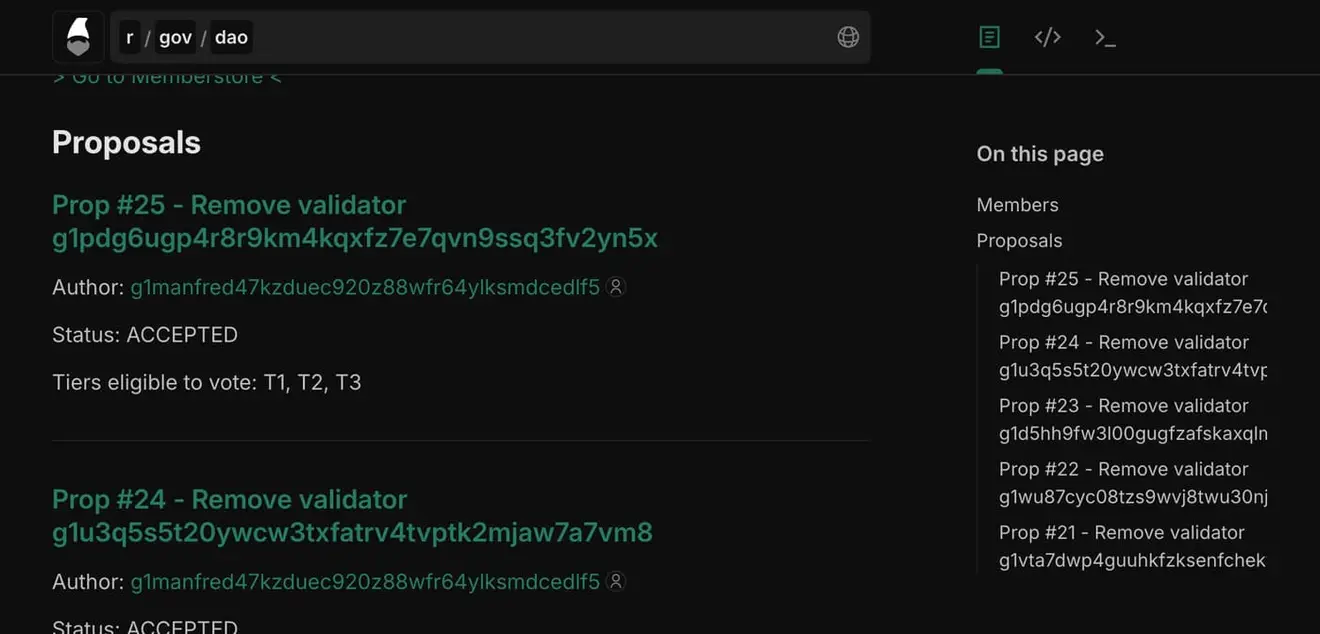
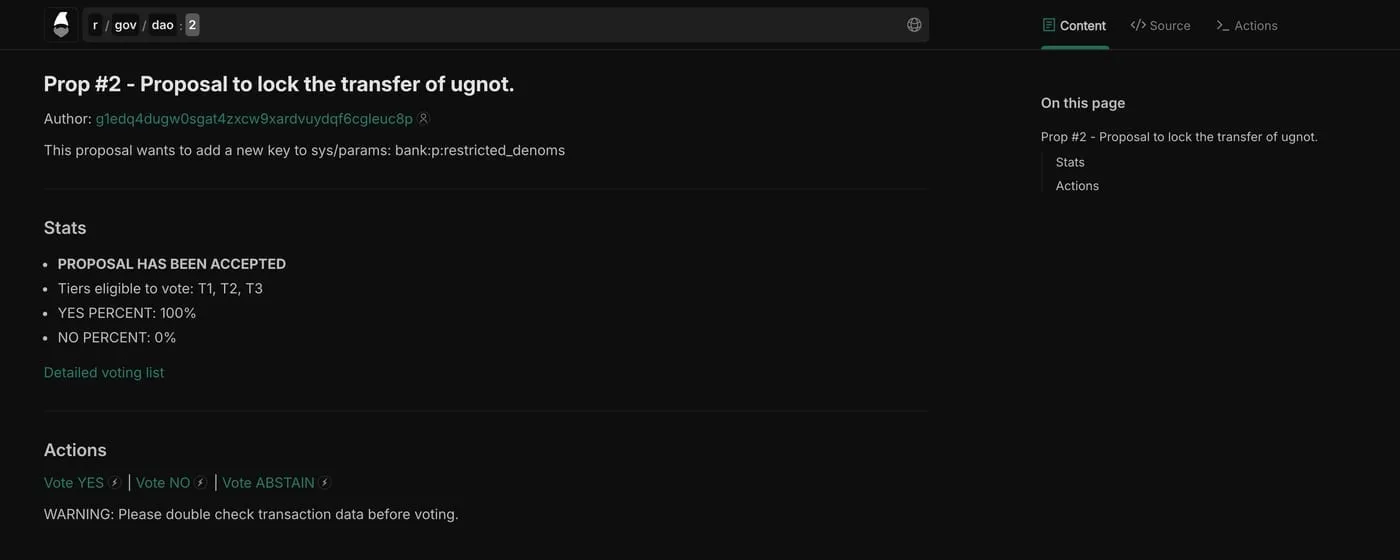
You can check the transfer lock yourself, which is the nice thing about a chain whose governance is a readable realm. GovDAO proposal #2 — “Proposal to lock the transfer of ugnot.” — passed with 100% in favour and added a bank:p:restricted_denoms parameter. Five proposals add unrestricted accounts — #1, and #4 through #7. Four of them come after the lock; #1 precedes it, at least by proposal number, which is the only ordering the realm exposes. Walk the full list of proposals and you will find validator additions, validator removals, a CLA update, a fee change — and, as of today, no proposal enabling transfers network-wide. The mechanism the launch post named for Phase II has not been exercised yet.
When is mainnet?
Q3 2026 is the window the project has published, and we would not be surprised to see it slip into the autumn.
Be clear about where that comes from, because the sourcing is thinner than the confidence usually attached to it. The GNOT sale page carries a roadmap whose Q3 2026 entry is headed “Mainnet Launch” and promises “a fully interoperable and security-hardened network with protocol-level GNOT transfers enabled”. The same entry also describes the July public sale, which has since closed. A quarter is the only granularity the project has published for mainnet itself — the same page dates the sale to the day, 20–27 July 2026, so the vagueness belongs to this milestone rather than to the project’s house style. The launch post says only “Timelines for each phase will be communicated as they solidify.”
So: a quarter from the project, a guess from us clearly labelled as ours, and no announced day from anyone. If you are planning around it, plan around the GovDAO proposal — that vote is the event, and it will be visible on-chain before any announcement.
What actually runs today
The beta mainnet carries a modest, real set of realms — the explorer at gno.land/r reports the count live, labelled “Packages”, and it is dozens rather than thousands. That is a narrower number than the ecosystem-wide package counts quoted elsewhere; it is what is deployed on this chain today. What is deployed is infrastructure and governance rather than consumer applications: GovDAO and its treasury, the validator registry, the on-chain Boards forum, the blog, a handful of GRC-20 pieces, and a scattering of user realms.
Tooling is further along than the application layer. Gnoscan and the Adena wallet, both from Onbloc, work today. So do the Playground, the Faucet Hub and the network status page.
Testnets ship often, and each is its own chain rather than a continuation of the last. Four landed between 15 June and 26 August: Test13, then Topaz on 17 July, Sapphire on 7 August and Pearl (Test16) yesterday. Pearl runs as pearl-1; the networks reference carries the live chains’ IDs, and each archived testnet’s is in its own genesis script in the monorepo. Alongside them, staging is the always-current rolling network — “a nightly build of the Gno tech stack”, in the docs’ phrase. If you last looked at Gno.land when the Portal Loop was the rolling testnet, that role belongs to staging now. The current list always lives in the networks reference.
What we build on it
Our work in this ecosystem is public, and most of it is Go and TypeScript in the open:
- gnodaokit — a framework for building DAOs in Gnolang.
- gnomonitoring and gno-validator-tools — monitoring, and an infrastructure-as-code toolkit for running validator and sentry nodes.
- Zenao — open-source event ticketing and community coordination. We run it ourselves at the Hyper Hacktive Festival, where our own engineers work the door.
- Memba (source) — a Gno-native multisig wallet and DAO governance application. Gnolove, our contribution tracker, now lives inside it.
The Governance Research Lab is the other half of that: the research on cooperative and decentralised governance is what the tools come out of, and the French Coopérative & Web3 glossary is one of its published outputs.
How to check any of this yourself
That is the actual point of a chain whose contracts are source and whose governance is a public realm. Three links do most of the work:
- gno.land/r/gov/dao — every governance proposal, its status and its vote. This is where mainnet becomes real.
- docs.gno.land/resources/gnoland-networks — which networks exist right now, with their chain IDs and RPC endpoints.
- github.com/gnolang/gno — the monorepo, its milestones and its open issues.
We will write again when the GovDAO vote lands. Until then, the honest summary is the one at the top: the chain is live, the token cannot move yet, and the vote that changes that has not been proposed.